
Safeguarding
Safeguarding
Safeguarding in Our Parish
Safeguarding is the Church’s commitment to protect the dignity, safety, and wellbeing of every person, especially children, young people, and adults who may be vulnerable. It is an expression of our Christian mission: to create a community where all feel welcomed, valued, and safe to grow in faith.
In our parish, safeguarding is a shared responsibility rooted in care, vigilance, and respect. We follow the safeguarding standards of the CSSA (Catholic Safeguarding Standards
Agency) and the procedures of the Diocese of East Anglia. Our Parish Safeguarding Representatives support this work by promoting good practice, offering guidance, and responding appropriately to any concerns that may arise.
We strive to foster a culture of transparency, compassion, and accountability, ensuring that our parish remains a place where the love of Christ is reflected in the way we protect and care for one another.
-
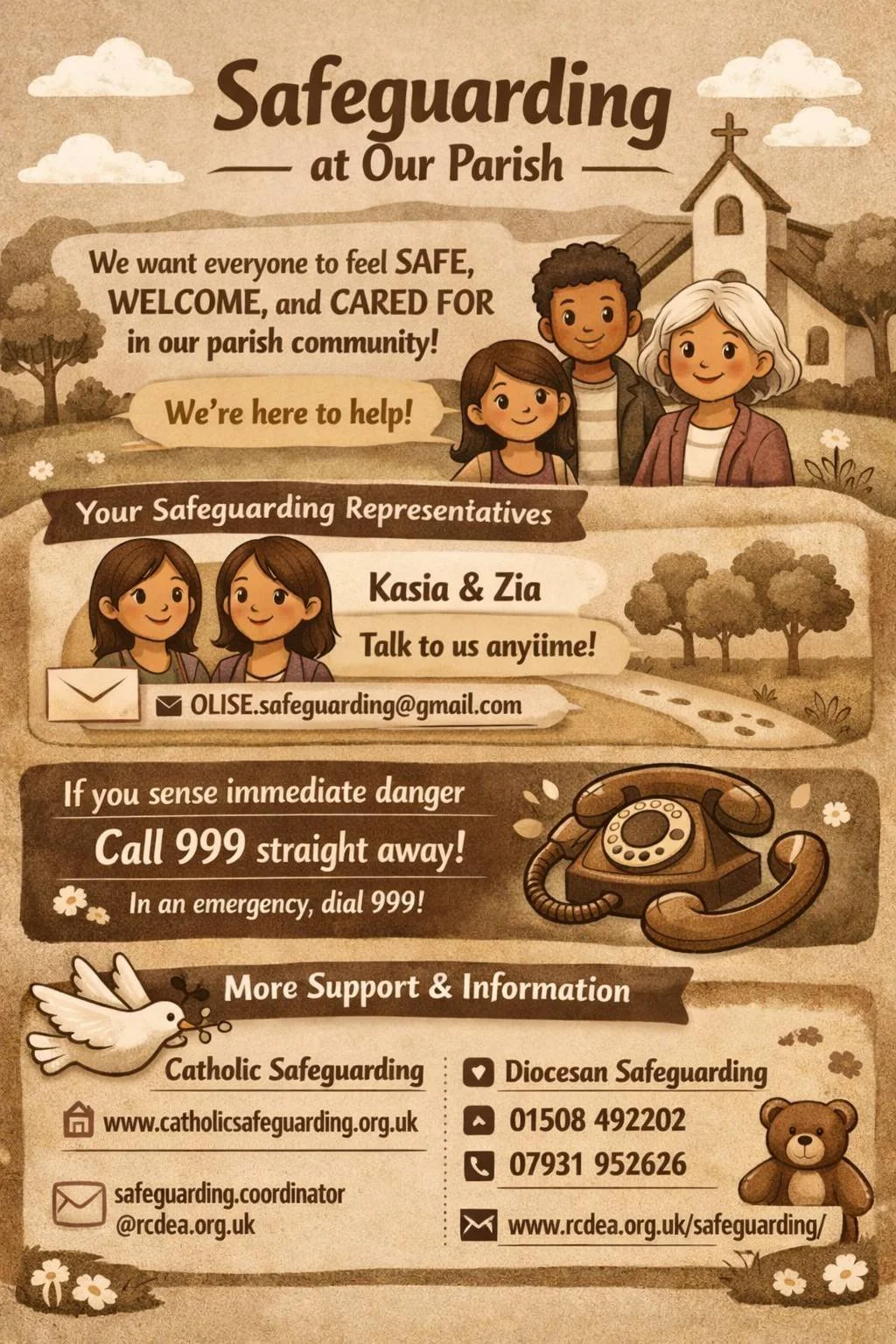
Our parish safeguarding representatives, Kasia and Zia, are here to help ensure that our parish is a safe and caring place for everyone — especially children, young people, and adults at risk.
If you have any safeguarding concerns or wish to report an incident, please contact them at: 📧 OLISE.safeguarding@gmail.com 📞 01638 662492
All reports and conversations will be treated confidentially. However, if there is immediate risk or danger, the matter will be reported to the appropriate authorities to ensure safety and protection.
-
If you have concerns about the immediate safety of a child, young person or adult then please contact the emergency services immediately, dialling 999.
Diocesan Safeguarding Coordinator: Mr Liam Sainsbury
Office telephone: (01508) 492202 | Mobile telephone: 07931 952626
Email: safeguarding.coordinator@rcdea.org.ukDiocesan Safeguarding Administrator: Mrs Donna Wright
Office telephone: (01508) 492202 | Mobile telephone: 07931 952628
Email: donna.wright@rcdea.org.uk -
Action on Elder Abuse Helpline: 0808 808 8141 (lines open Monday to Friday: 9.00am to 5.00pm)
Childline: 0800 1111 (phone if you are a child or young person and are worried about anything – lines open 24 hours)
Cruse (bereavement helpline): 0800 808 1677 (lines open Mondays and Fridays: 9.30am to 5.00pm (excluding Bank Holidays); Tuesday to Thursday: 9.30am to 8.00pm)
NAPAC – National Association for People Abused in Childhood: 0808 801 0331 (support for adults abused as children – lines open Monday to Thursday: 10.00am to 9.00pm; Fridays: 10.00am to 6.00pm)
National Domestic Violence Helpline: 0808 2000 247 (phone if you are experiencing domestic abuse – lines open 24 hours)
NSPCC Child Protection Helpline: 0808 800 5000 (phone if you are worried about a child – lines open 24 hours)
Samaritans Helpline: 116 123 (phone if you feel you are struggling to cope and need someone to talk to – lines open 24 hours)
Stop It Now: 0808 1000 900 (preventing child sexual abuse – lines open Monday to Thursday: 9.00am to 9.00pm (excluding Bank Holidays); Fridays: 9.00am to 5.00pm)
Survivors Trust: 08088 010 818 (support for men who have experienced sexual assault or rape – lines open Mondays and Wednesdays: 10.00am to 7:30pm; Tuesdays: 10.00am to 12.00 noon and 1:30pm to 7:30pm; Thursdays: 10.00am to 4.00pm and 5.00pm to 7:30pm; Fridays: 10.00am to 2.00pm) -
Safe Spaces – Independent Support and Reporting
If you wish to report a safeguarding concern but would prefer not to speak with our Parish Safeguarding Representatives or the Diocesan Safeguarding Team, you can contact Safe Spaces using the link below.
Safe Spaces is an independent service offering confidential support to anyone who has experienced abuse within the Catholic Church or Church of England. They provide a safe, non‑judgemental place to talk, receive guidance, and access specialist help from trained professionals who are completely separate from the Church.
-
For further details about the roles and responsibilities of those who serve within our Diocese, please visit the Diocesan website using the link below. It offers helpful guidance, explanations, and up‑to‑date information.
-
For those who wish to learn more about safeguarding within the Catholic Church, further guidance, policies, and national standards can be found on the Catholic Safeguarding Standards Agency (CSSA) website via the link below.
Please click here for the CSSA Website.
If you would like to deepen your understanding or undertake additional training, the Diocese recommends completing Safeguarding Training – Level 3. The link to this training is also provided below.
-
St Josephine Bakhita (1869–1947)
St Josephine Bakhita was born in Darfur, Sudan. As a young child she was kidnapped by slave traders and forced to walk hundreds of miles. Sold repeatedly, she endured severe cruelty and violence. She later recalled that during those years, “I do not remember a single day without some wound or other.”
Her life changed when she was taken to Italy and placed temporarily with a community of religious sisters. When her owner attempted to reclaim her, the sisters protected her, and a court ruled that slavery had no legal standing in Italy. She remained with the sisters, was baptised, and eventually entered religious life.
St Josephine became known for her deep faith, forgiveness, and serenity. Reflecting on her past, she once said that if she were to meet those who had harmed her, she would “kneel and kiss their hands,” because her journey—however painful—had led her to Christ. Today she is honoured as a modern African saint and a powerful witness against the evils of slavery and human trafficking. Pope St John Paul II proclaimed: “Rejoice, all of Africa! Bakhita has come back to you… free with the freedom of the saints.”
Her feast day is 8 February, now widely associated with prayer and action against human trafficking and modern slavery.
If you are concerned about any incidents of modern slavery within our parish or local community, please contact 999 immediately, and inform your Parish Safeguarding Representative and the Diocesan Safeguarding Team.
St Josephine Bakhita, pray for us.